First principles
Every diet works. Almost nobody can stay on one.
What decides whether the weight stays off isn't which foods you cut. It's whether you're hungry. Here is what actually moves hunger, and what doesn't.

Dr. Andreas Eenfeldt, MD · · 7 min read
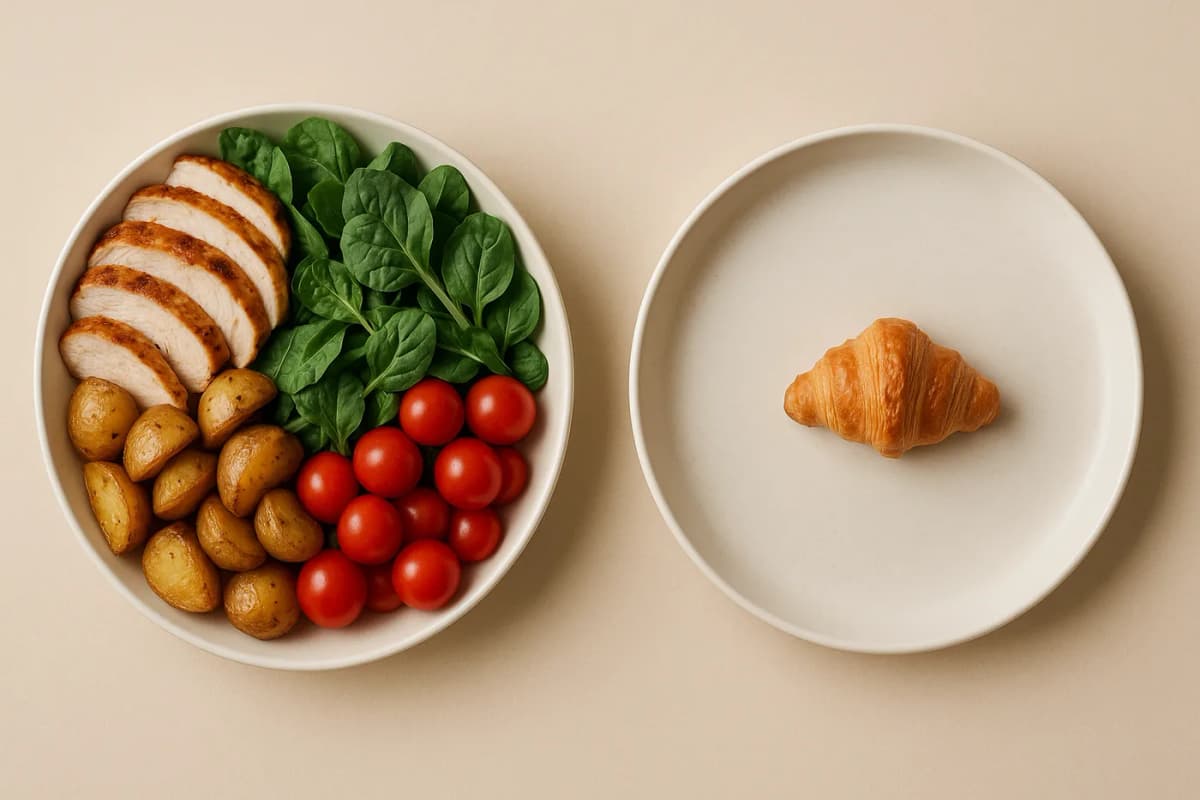
You have probably lost weight before. Most people have. Losing it was never the hard part.
The hard part shows up a few months in, when the food you gave up starts occupying more of your attention than it used to, and holding the line costs something you don't always have to spend. Then a bad week arrives. The weight comes back. And you file it under personal failure.
That conclusion is wrong, and there is a specific experiment that shows why.
The diet wars had a referee
In 2018 Stanford ran the trial the argument deserved: 609 adults, randomly assigned to a healthy low-fat or a healthy low-carbohydrate diet, for a full year, with ongoing professional support. Both groups were told to build meals from whole foods and cut added sugar and refined grain. This was not a magazine plan. If the macronutrient split were the answer, this is where it would show.
Two diets, twelve months, effectively the same result
Average weight lost by 609 adults randomly assigned to a healthy low-fat or a healthy low-carbohydrate diet. Whiskers show the 95% confidence interval.
Healthy low-fat diet
Healthy low-carbohydrate diet
kilograms lost after 12 months
The gap between the diets was 0.7 kg — small enough that it could easily be chance. Inside each group, individual results ran from about 30 kg lost to 10 kg gained.
Source: Gardner 2018
It didn't show. Low-fat lost 5.3 kg, low-carb lost 6.0 kg, and the 0.7 kg between them sat comfortably inside the margin of error. But the more interesting number is the other one: within each group, individual results ran from roughly 30 kg lost to 10 kg gained. The spread among people on the same diet dwarfed the difference between the diets.
So “which diet” was never the question worth asking. The question is what makes one person able to keep going while another can't.
The body fights back, and it is patient
Every method that produces weight loss — food, drugs, surgery — does the same physical thing underneath: it creates an energy deficit and sustains it. What separates the methods is how tolerable that deficit is to live inside.
And it gets less tolerable over time, by design. As fat falls, appetite rises and energy expenditure drops. The gap widens the longer you hold the line. This isn't a metaphor about motivation, it's regulation, and it does not get tired or distracted. You do.
Consider the best-resourced lifestyle program ever run: intensive counseling, years of follow-up, a research team behind every participant. It produced 8.6% weight loss at one year and about 6% still off at ten. That is roughly the ceiling of what heroic, well-supported effort buys. Initial loss is the easy part. Maintenance is the entire problem.
And what breaks maintenance, over and over, is hunger.
Hunger is not a character trait
Here is the finding that reframes everything: hunger is not fixed, and it is not mostly about you. It responds — measurably, and by a lot — to the properties of the food in front of you.
The cleanest demonstration comes from the NIH metabolic ward. Twenty adults lived in, and each person ate both diets: two weeks ultra-processed, two weeks unprocessed, matched for calories, sugar, fat and fiber on offer. They were told to eat as much or as little as they liked. On the ultra-processed weeks they ate about 500 kcal a day more, and gained weight.
Nobody decided to overeat. Same people, same instructions. The food did it.
A second trial from the same lab sharpens the point. This time a low-fat plant diet at 1.1 kcal per gram was tested against an animal-based ketogenic diet at 2.2 kcal per gram. The keto arm produced much lower insulin, which is precisely the mechanism the carbohydrate-insulin theory says controls appetite. People ate 689 kcal a day more on it. Energy density beat carbohydrate, in the direction the theory did not predict.
Change the food, and daily intake moves by hundreds of calories
Extra calories eaten per day when people were given denser or more processed food, with no instruction to eat more or less.
Ketogenic diet vs low-density plant diet· Hall 2021 · 20 adults, metabolic ward
Ultra-processed vs unprocessed meals· Hall 2019 · 20 adults, metabolic ward
Higher- vs lower-density meals· Klos 2023 · 38 trials, 1,831 people
extra calories eaten per day
Three different designs, three different comparisons, one direction. In every case the food was freely available and nobody was told what to eat.
You eat a volume, not a number
The mechanism underneath is almost embarrassingly simple, and it is the sentence this whole approach rests on.
Your body is not counting calories. It is measuring food.
Pool 38 randomized trials and you can watch it happen: lower the calories per gram, and people eat 223 fewer calories a day — while the weight of food they put away barely changes. A separate meta-analysis of 31 studies finds the same effect, and finds little evidence that people quietly make up the difference later.
Protein does a parallel job on a different axis. Dilute the protein in a diet and people keep eating until they reach roughly the protein they were after, dragging the extra calories along with it — and it makes no difference whether the dilution comes from carbohydrate or from fat. Stage it deliberately, with the same 28 foods and the protein quietly moved from 15% of calories down to 10%, and intake rises about 12%. Move it up to 25% instead and nothing happens.
Put those side by side and you have one number with a name: how full a food makes you, per calorie it costs. Food that is watery, fibrous and protein-rich fills you up early and cheaply. Food that is dense, protein-poor and fast to eat fills you up late and expensively — and that second kind is exactly what rose alongside the epidemic, as the historical data show.
Where this stops being true
Every framework has an edge. Here are ours, stated before anyone has to point them out.
What this means for you
Three things, and the first one matters most.
It was never willpower. You were running century-old appetite regulation against food engineered to get past it. Losing that contest is a design outcome, not a character defect — and the blame framing is precisely what keeps the design unexamined.
Change what fills you, not how hard you try. The evidence points at one action, and it is not eating less. It is eating food that returns more fullness per calorie, in a volume that actually satisfies you. Restriction is what fails; substitution is what holds.
Any way of eating can be built this way.Low-carb, plant-based, omnivore — the label is not the variable. Water, protein and fiber are the three ways a food earns its keep, any one of them enough on its own, and sugar and engineering are what take it back. That is what we score, using Ted Naiman's satiety-per-calorie model, v14-S — Sately runs it unchanged as formula 3.0 — and we publish it so you can check it.