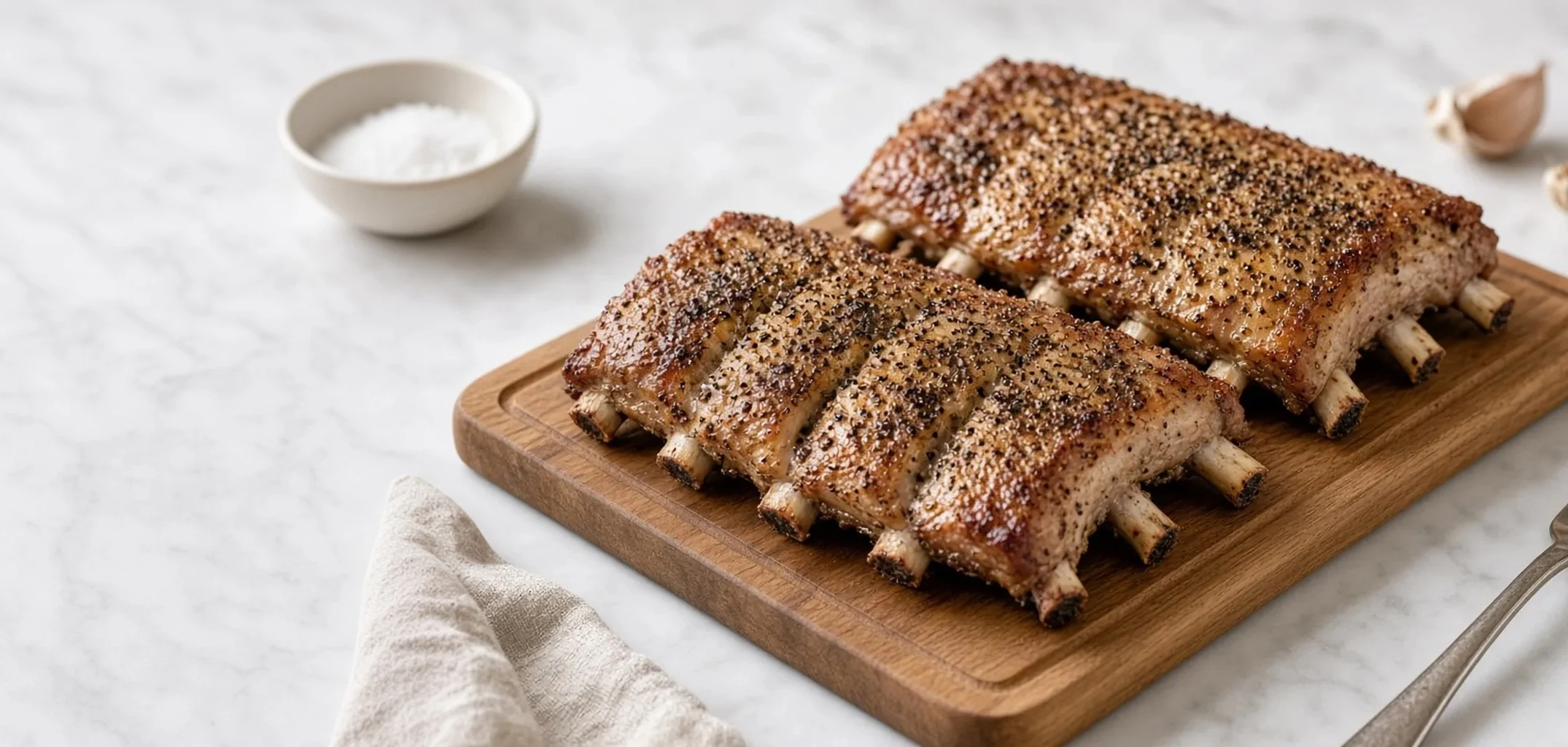
Salt-and-pepper baby back ribs
195 min · 62 g protein · 769 cals / serving
Two racks of pork ribs seasoned with a heavy hand of salt and black pepper, sealed in foil and baked low until the meat slides off the bone, then crisped under the grill. No sauce and no sugar, so the pork and the pepper crust do all the talking.
Ingredients
- 2 racks baby back ribs, about 4 1/2 lb with bone pork ribs, weighed as 1,300 g raw meat off the bone
- 2 tsp kosher salt salt
- 2 tsp black pepper, coarsely ground
- 1 tsp garlic powder (optional)
- 1 tsp paprika (optional)


Steps
- Heat the oven to 275°F. Turn the racks bone side up. Slide a butter knife under the thin membrane at one end, grip it with paper towel and pull it off in one sheet.
- Mix the salt, pepper and, if using, the garlic powder and paprika. Rub it over both sides of the racks, most of it on the meaty top.
- Lay each rack meat side up on a large sheet of foil and fold the foil over into a tight parcel. Set the parcels on a rimmed tray and bake 2 1/2–3 hours, until a skewer slides between the bones with no resistance and the meat has shrunk back from the bone ends. Pork is safe from 145°F; tender ribs reach about 195–203°F.
- Turn on the oven grill (broiler) to high. Open the parcels carefully, away from your face, and pour off the fat and juices. Lay the racks meat side up on the tray and grill 3–5 minutes, watching closely, until the top sizzles and crisps at the edges.
- Rest 10 minutes, then cut between the bones and serve.
Good to know
Can I use spare ribs?
Yes. They are bigger and fattier, so give them 3 1/2–4 hours in the foil and check with the skewer.
Can I make them ahead?
Bake them in the foil a day ahead and refrigerate. Before serving, warm the parcels at 300°F for 25 minutes, then grill as in step 4.
Per
- Calories
- 319
- Protein
- (33%)
- 26 g
- Fat
- (66%)
- 23 g
- Carbohydrates
- (1%)
- 1 g
- of which sugar
- <1 g
- Fiber
- <1 g
- Sodium
- 563 mg
More meals


Computed from the ingredients with our published formula, not yet kitchen-tested. How
As written, 3074 kcal goes into the pot and 1323 g of ingredients comes out as about 965 g of food: 319 kcal per 100 g. Cooking moves water and energy density is the score's biggest lever, so the dish is scored as cooked, not as an average of its parts. Every ingredient links to its food page, with the same data and score. The label's percentages are each macronutrient's share of the calories. The full formula.