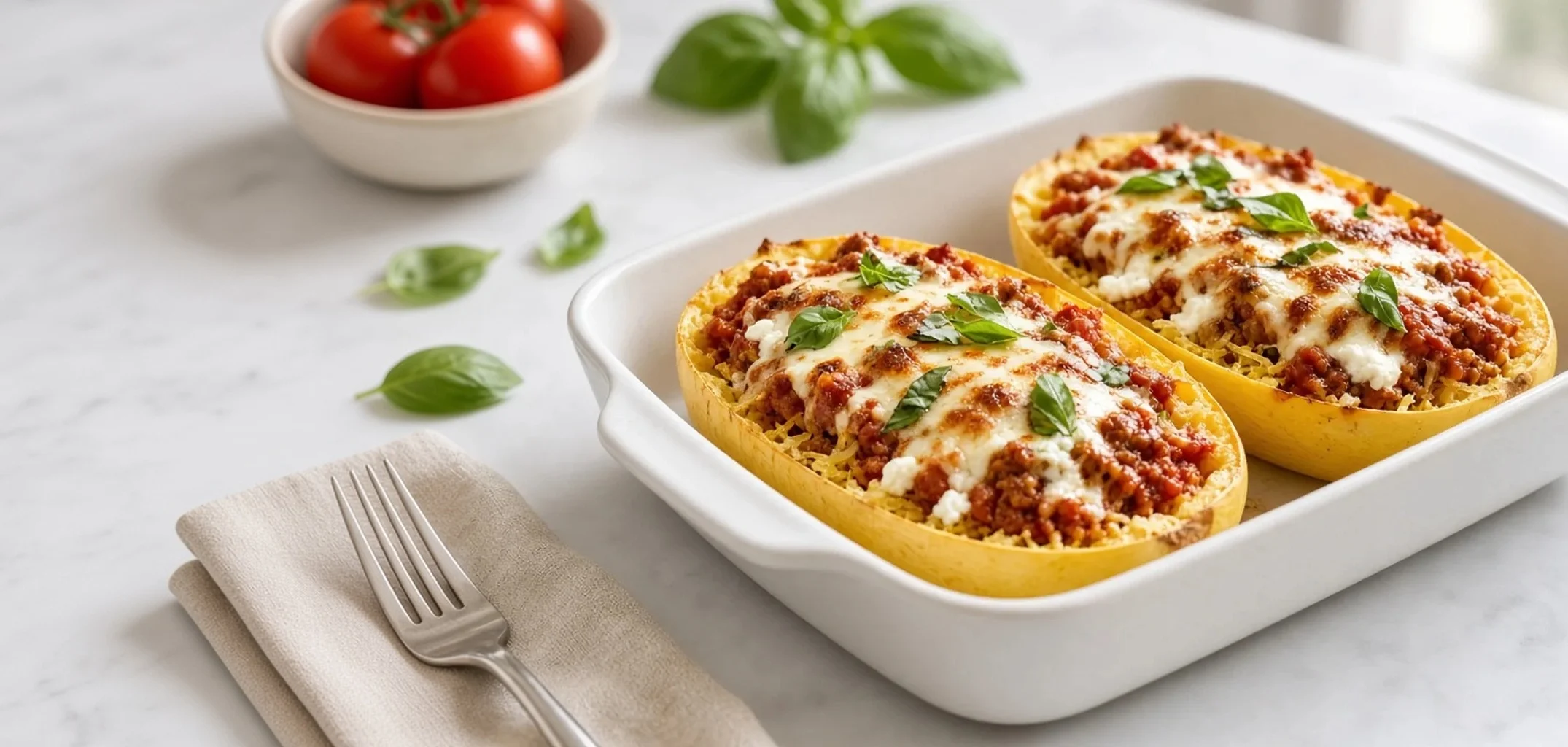
Spaghetti squash lasagna boats
85 min · 46 g protein · 488 cals / serving
Roasted spaghetti squash halves filled with their own tender strands, a garlicky beef and tomato sauce and a creamy ricotta layer, then baked under bubbling mozzarella. Every boat tastes like a corner piece of lasagna, with the squash standing in for the noodles.
Ingredients
- 2 small spaghetti squash, halved lengthwise, seeds scooped out
- 2 tsp olive oil
- 1 tsp salt, divided
- 1 lb 2 oz ground beef (93% lean)
- 1 small onion, finely chopped
- 3 cloves garlic, minced
- 1 1/4 cups canned crushed tomatoes
- 1 tsp Italian seasoning
- 1/2 tsp black pepper


Cheese layer
- 1/2 cup part-skim ricotta
- 1/2 cup cottage cheese (2%), blended smooth
- 1 large egg
- 1/4 cup grated parmesan


- 1 cup shredded mozzarella cheese
- a small handful fresh basil, torn (optional)


Steps
- Heat the oven to 400°F. Brush the cut sides of the squash with the oil and season with half the salt. Roast cut-side down on a lined tray for 35–45 minutes, until a knife slides easily through the skin.
- Meanwhile brown the beef in a large skillet over medium-high heat, breaking it up, 6–7 minutes until no pink remains and it reaches 160°F. Add the onion and cook 4 minutes, then the garlic for 30 seconds.
- Stir in the crushed tomatoes, Italian seasoning, pepper and the rest of the salt. Simmer 10 minutes, until thick enough that a spoon leaves a trail.
- Stir the ricotta, blended cottage cheese, egg and parmesan together in a bowl.
- Turn the squash halves over and fluff the strands with a fork, leaving them in the shells. Spoon half the meat sauce into the boats, dollop the cheese mixture over it, top with the rest of the sauce and scatter with the mozzarella. Bake 15–20 minutes, until the cheese is melted and bubbling and starting to brown at the edges.
- Rest 5 minutes and scatter with basil. Keeps 4 days in the fridge; reheat covered in the oven or at half power in the microwave.
Good to know
Can I microwave the squash to save time?
Yes. Pierce the halves, put them cut-side down in a dish with a splash of water, cover and microwave 10–14 minutes until tender. The strands come out a little softer than roasted ones.
Can I use all ricotta?
Yes, for a slightly richer, more classic layer, at about the same score.
Per
- Calories
- 121
- Protein
- (38%)
- 11 g
- Fat
- (45%)
- 6 g
- Carbohydrates
- (17%)
- 6 g
- of which sugar
- 3 g
- Fiber
- 1 g
- Sodium
- 400 mg
More meals


Computed from the ingredients with our published formula, not yet kitchen-tested. How
As written, 1951 kcal goes into the pot and 1938 g of ingredients comes out as about 1610 g of food: 121 kcal per 100 g. Cooking moves water and energy density is the score's biggest lever, so the dish is scored as cooked, not as an average of its parts. Every ingredient links to its food page, with the same data and score. The label's percentages are each macronutrient's share of the calories. The full formula.